




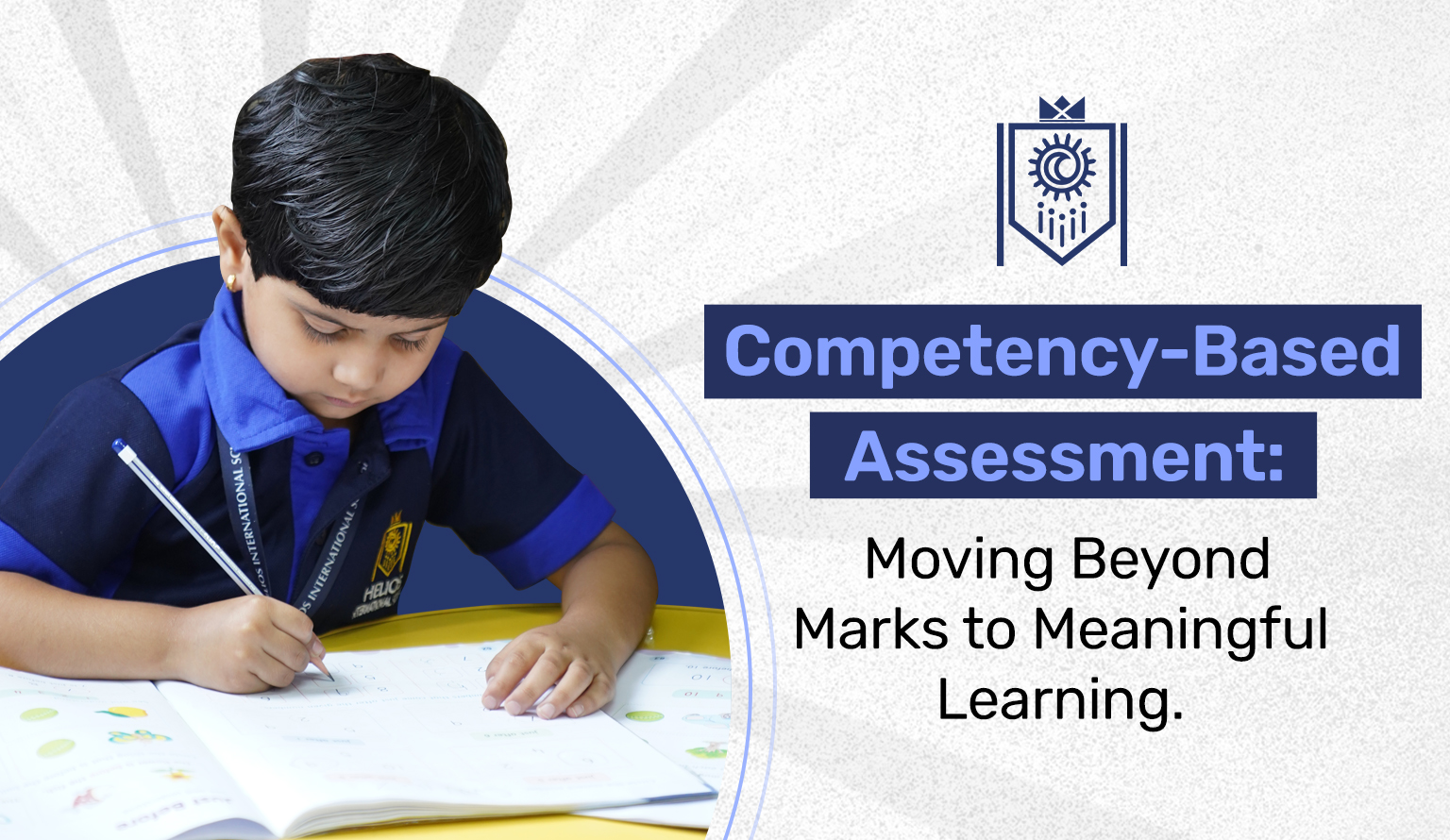
Summary - Competency-based assessment offers a transformative approach to modern education by shifting the primary focus from traditional numerical marks to actionable skill mastery. Instead of relying solely on high-stakes standardised tests, this framework evaluates students on their ability to apply knowledge effectively and demonstrate real-world competence. By allowing learners to progress at their own pace and receive targeted feedback, educators can cultivate deeper engagement, support individual learning journeys, and foster a more equitable, future-ready environment focused on lifelong success.
"Education is not the learning of facts, but the training of the mind to think.” — Albert Einstein
For years, assessments in CBSE schools in Pune have largely focused on one question: How much can a student remember?
But education is evolving. Today, the focus is gradually shifting towards a more meaningful question: How well can a student understand, apply, analyse, and use what they have learned in real-life situations?
This is where Competency-Based Assessment (CBA) comes in. It is an important assessment reform that moves learning beyond memorisation and encourages students to think, solve, create, and grow.
More About Competency-Based Assessment:
To put it simply, Competency-Based Assessment evaluates not just what students know, but how effectively they can use their knowledge and skills.
So instead of relying only on direct, memory-based questions, students may be asked to:
- Apply concepts to real-life situations
- Analyse information and make connections
- Solve practical or unfamiliar problems
- Think critically and explain their reasoning
- Collaborate, communicate, and create solutions
For example, rather than simply asking a student to recall a mathematical formula, an assessment may present a real-world situation and ask them to decide which concept to use and why.
Here, the goal is not to make learning more difficult. It is to make learning more relevant and purposeful.
Why Is This Shift Important?
We all know how the world students are preparing for is changing rapidly. Success today requires more than the ability to remember information. Students need curiosity, adaptability, creativity, communication skills, and the confidence to approach unfamiliar challenges.
Competency-based learning helps nurture these abilities by encouraging students to understand concepts deeply rather than study only for marks.
The true purpose of assessment is not just to measure learning, but to improve it.
This approach also allows teachers to identify a student’s strengths and areas for growth more clearly. Instead of viewing a test as a final judgement, assessment becomes an ongoing part of the learning journey.
Note - Assessment Is More Than Examinations
One of the biggest advantages of competency-based assessment is that learning is evaluated throughout the academic year, not just during final examinations.
Teachers assess students through projects, presentations, classroom discussions, practical activities, collaborative tasks, and regular feedback throughout the year. This helps students identify their strengths, improve steadily, and build confidence without seeing examinations as the only measure of success.
Skills Developed Through Competency-Based Learning
Competency-based learning, along with academic knowledge, helps students develop essential skills that are valuable in higher education and future careers.
Some of these include:
- Critical thinking and analytical reasoning
- Problem-solving abilities
- Communication and presentation skills
- Creativity and innovation
- Collaboration and teamwork
- Decision-making and adaptability
- Self-reflection and independent learning
- Confidence in applying knowledge to real-world situations
How Can Parents Support Competency-Based Learning?
Parents play an equally important role in helping children benefit from this approach to learning. Instead of focusing only on marks, they can encourage children to develop curiosity, confidence, and a genuine love for learning.
Here are a few simple ways parents can support competency-based learning:
- Encourage children to ask questions and explore different ideas.
- Appreciate effort, improvement, and problem-solving, not just scores.
- Discuss real-life situations that connect classroom concepts with everyday experiences.
- Give children opportunities to think independently and make decisions.
- Maintain regular communication with teachers to understand their child's overall development.
- When schools and parents work together, children develop stronger conceptual understanding and become more confident learners.
What Does Competency-Based Assessment Look Like at Helios International School?
Being one of the progressive CBSE schools in Pune, at Helios International School, competency-based assessment includes:
- Case-study and situation-based questions
- Experiments and practical activities
- Projects and presentations
- Open-ended questions with multiple approaches
- Group tasks and collaborative learning
- Reflection-based activities
- Real-life problem-solving exercises
At Helios International School, we believe that every child learns differently and brings unique strengths to the classroom.
A meaningful assessment should therefore do more than assign a score. It should help students understand their progress, build confidence, learn from mistakes, and develop the skills they need for the future.
As one of the emerging choices among parents looking for the best CBSE school, our focus is on creating learning experiences that are engaging, relevant, and connected to life beyond the classroom.
From “What Did You Memorise?” to “What Can You Do?”
Competency-Based Assessment represents a positive shift. Below are a few key shifts -
- From memorising answers to understanding ideas
- From repeating information to applying knowledge
- From focusing only on marks to recognising meaningful growth.
Because education is not only about preparing students for the next examination. It is about preparing them to think independently, solve confidently, and navigate the real world with curiosity and purpose.
.jpeg)